
Marriott and Google changed how guests find hotels. Here is what that means for your property
Hotel marketing in Atlantic Canada just changed
Two announcements landed in the same week in May 2026, and together they signal a fundamental shift in how guests find hotels. Marriott International is replacing keyword-based destination search with a conversational AI experience. Google confirmed at its I/O conference that traditional search is no longer the priority. For anyone responsible for hotel marketing in Atlantic Canada, these are not distant industry headlines. They describe the environment your next guest is already navigating. The question is whether your property is visible inside that environment, or invisible to it.
KEY TAKEAWAYS
- Marriott International is replacing destination-based hotel search with a conversational AI tool, rolling out in 2026.
- Google confirmed at I/O 2026 that AI-powered answers, not ranked links, will define how people search online.
- 98% of hoteliers have used AI across their operations in the last six months, according to the Mews Hotelier Survey 2026.
- Independent hotels in Atlantic Canada must audit their property descriptions, amenity data, and online content to remain discoverable by AI.
- Markanit Consulting can help Atlantic Canada properties build an AI-ready content strategy before the window closes.
What did Marriott announce, and why does it matter for your property?
Marriott International is moving away from keyword and destination-based hotel search in favour of a conversational AI tool that lets guests describe exactly what they want. According to Hotel Dive reporting from May 2026, CEO Anthony Capuano announced a phased rollout of the feature on Marriott's website and app beginning this quarter. As of June 2026, that deployment is underway.
Naveen Manga, Global Chief Information Officer at Marriott International, described 2026 as "a year for scale" during a virtual event, noting that 2025 was a year of experimentation and piloting. The new search experience processes complex, natural language queries. A guest could ask for a hotel near the ocean with connecting rooms and walking trail access. Marriott's AI tool then surfaces options matching those specifics through a continued conversation.
This matters for every property in Atlantic Canada for one clear reason. Guests arriving at any booking platform are being trained to search differently. If your property data, descriptions, and content cannot answer a natural language query, your hotel risks becoming invisible at the moment of discovery.
Hilton and Wyndham Hotels and Resorts have both launched conversational search tools in recent months as well, according to Hotel Dive. Choice Hotels International partnered with Amazon Web Services last month on an enterprise-wide AI deployment.
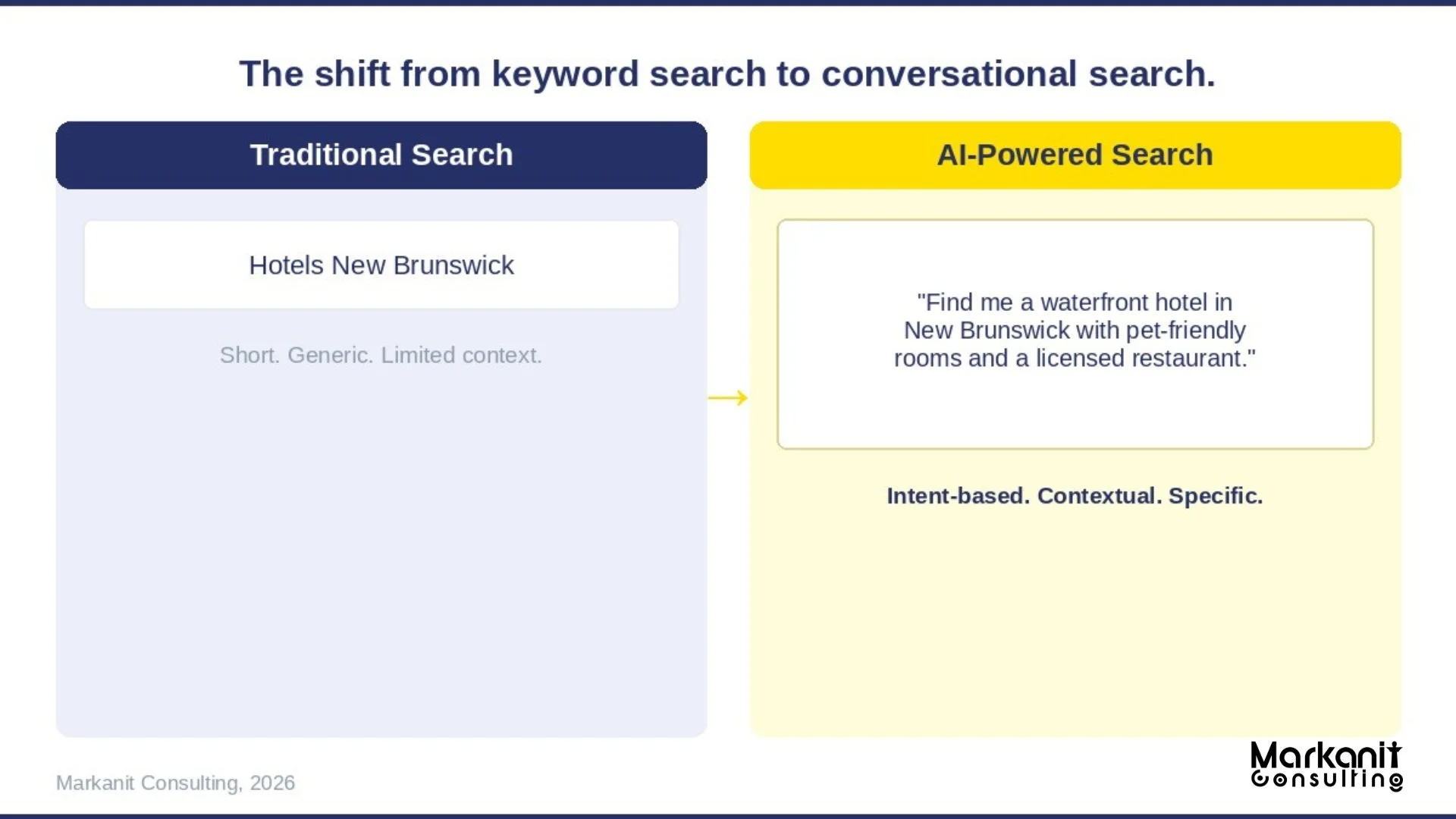
What did Google confirm at I/O 2026, and what has actually changed?
Google confirmed at its I/O conference on May 19, 2026, that traditional search is no longer the default experience. The company unveiled an AI-powered overhaul centred around a new intelligent search box, conversational AI answers, autonomous information agents, and interactive interfaces built in real time.
Writing for TechCrunch, journalist Sarah Perez reported that Google's AI Overviews now reach more than 2.5 billion monthly users. Google's conversational AI Mode, launched in 2025, surpasses one billion monthly users. These are not future projections. They describe how your potential guests are already searching.
The practical change for hotel operators is this: Google Search is shifting from returning a list of links to generating answers and recommendations directly inside the search results. Liz Reid, Google's head of Search, described a system where "Search can build custom experiences just for your individual questions." For a traveller looking for a boutique inn in New Brunswick, Google may now answer that query without ever sending the guest to your website.
This creates a new discoverability challenge. Your property must be described, structured, and cited in ways that AI systems can read and extract. A well-designed website with strong photography is no longer sufficient.
How widely has the hotel industry already adopted AI hotel marketing?
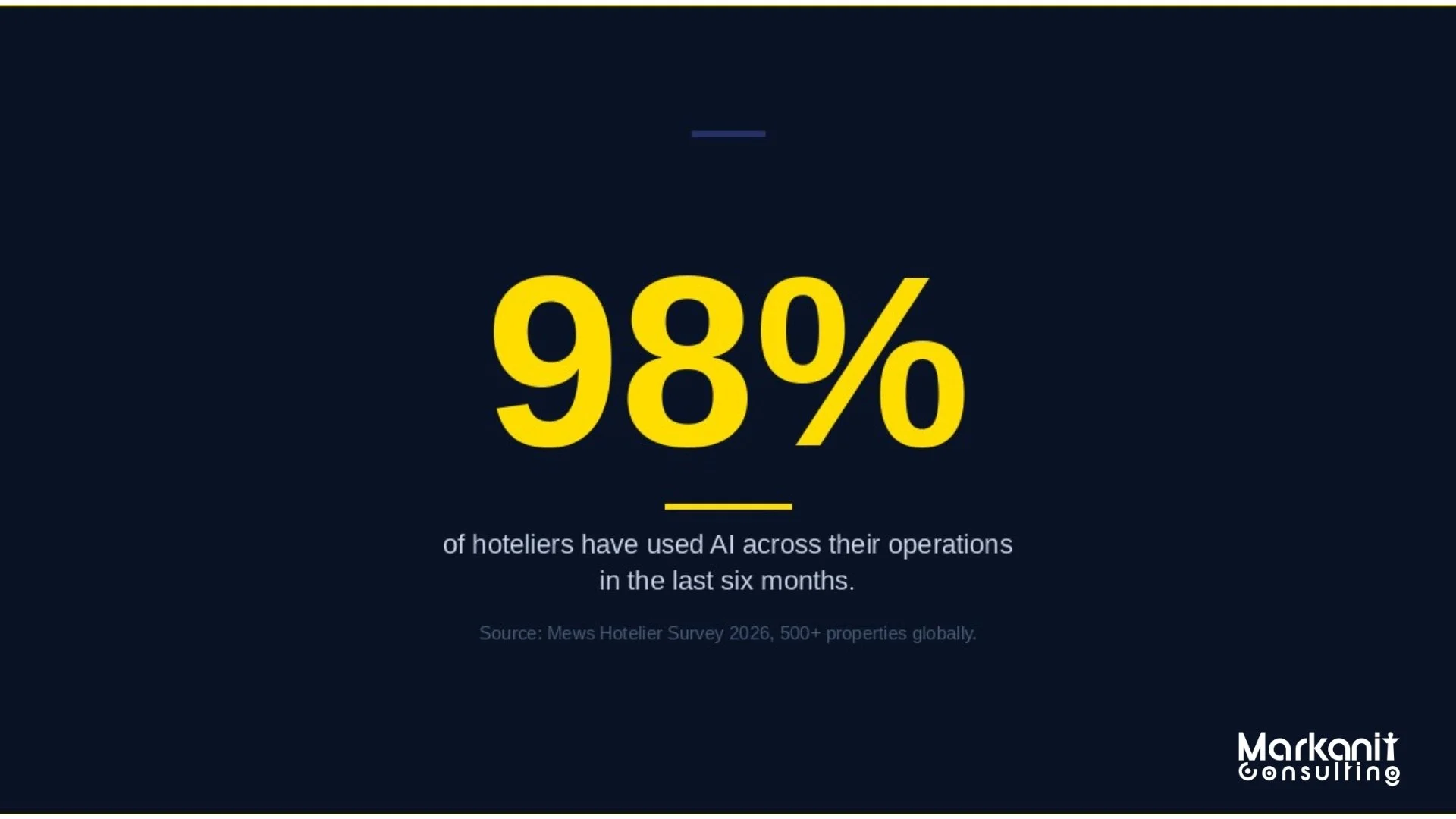
AI adoption in hotels is no longer a leading-edge strategy. It is the baseline. The Mews Hotelier Survey 2026 was conducted across more than 500 properties globally between December 2025 and March 2026. It found that 98% of hoteliers have used AI across their operations in the last six months.
The optimism behind that number is also notable. The same survey found that 92% of hoteliers are positive about AI's role in hospitality. These are not reluctant adopters being pushed by technology vendors. They are operators who have tried AI tools and seen results.
The more telling finding is this: 41% of those same hoteliers have no formal AI policy in place. They are using AI daily without a strategy guiding how, where, or why. For independent properties in Atlantic Canada, that gap between adoption and governance is exactly where a structured AI hotel marketing strategy delivers the most value.
What does this mean for how guests find your property and what should you do right now?
Traditional hotel SEO focused on keywords, backlinks, and page speed. AI hotel marketing strategy adds new requirements. AI systems surface hotel recommendations based on how clearly a property's content matches a guest's stated needs. Amenity descriptions, room configurations, location context, dining information, and guest experience details must be explicit, not implied.
Here is what a property needs to remain discoverable:
Complete and consistent descriptions across your website, Google Business Profile, and all booking platforms.
Specific amenity language that mirrors how guests describe what they want, not how hotels traditionally categorize features.
Regular, original content that gives AI systems current and credible information about your property and its surroundings.
Structured data markup on your website so search engines and AI tools can extract key property information accurately.
Active management of reviews and third-party citations, since AI tools weight credible external sources heavily.
Begin by auditing your property descriptions. Read your website, your Google Business Profile, your OTA listings, and your social media profiles as if you were an AI system extracting information. Are your amenities described explicitly? Is your location context specific? Does your content answer the kinds of questions a guest would ask in a natural language search?
Next, identify the gaps. List every amenity, experience, and attribute your property offers that is not clearly described online. Pet-friendly policies, accessibility features, dining hours, parking details, room configurations, and proximity to local attractions all need to be findable by AI.
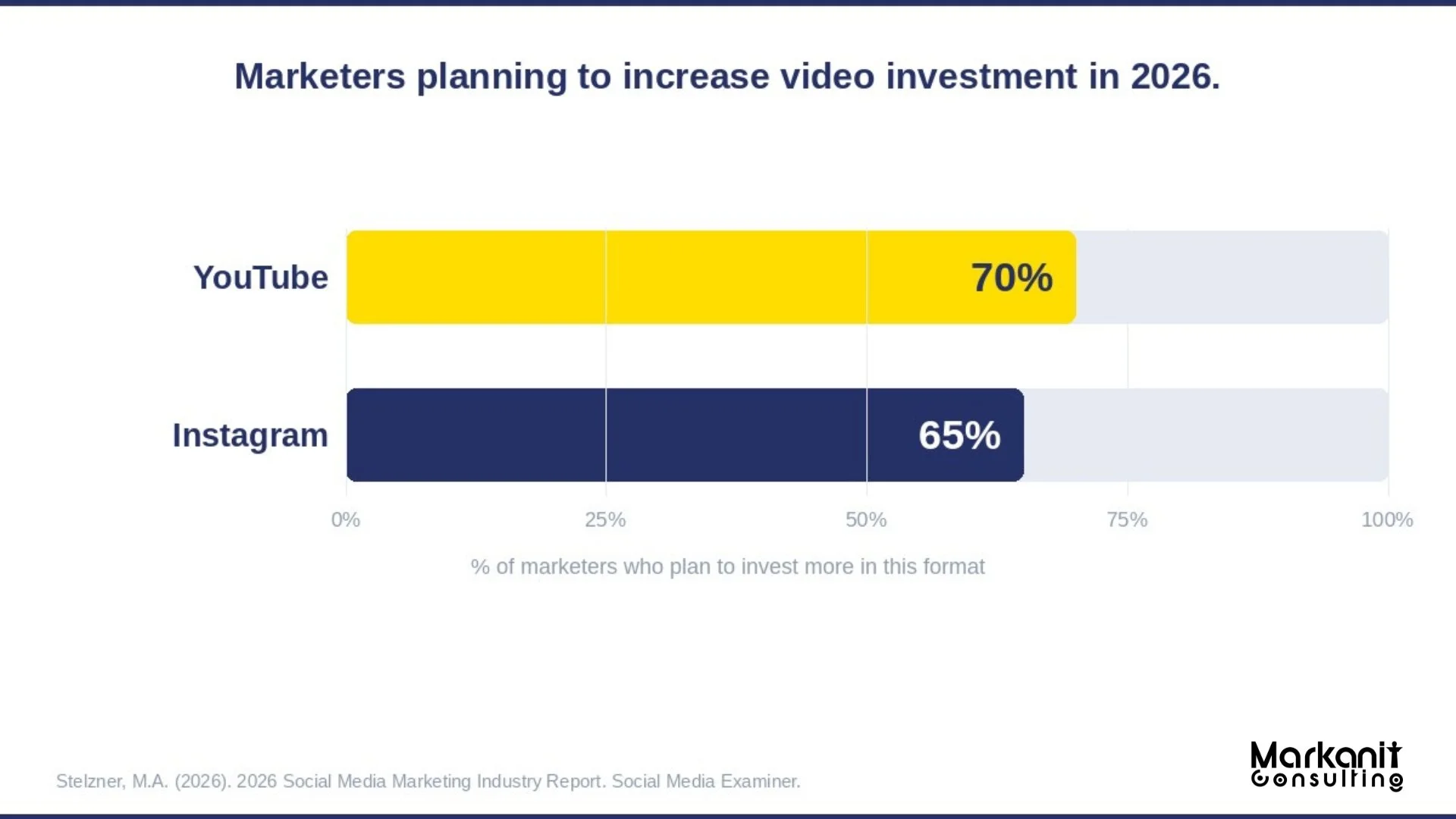
Then prioritize consistent content. The 2026 Social Media Marketing Industry Report found that 70% of marketers plan to increase their YouTube video marketing and 65% plan to increase their Instagram video over the next 12 months. Video content describing your property and its surroundings gives AI systems rich, indexable material to work with. A content calendar built around your property's seasonal attributes is a practical starting point.
For a deeper look at how the 2026 social media data translates into hospitality marketing strategy, see Markanit Consulting's analysis here.
How can a hotel marketing consultant in Atlantic Canada help?
Markanit Consulting is a Fredericton-based marketing advisory founded on direct hotel experience at Fairmont Château Laurier, Crowne Plaza, and Hilton Garden Inn. CHDM-certified and built for hospitality and tourism businesses, Markanit works with property owners and leadership teams across Atlantic Canada and Canada on structured, AI-ready marketing strategy.
Each engagement starts with a detailed intake review and delivers a written strategic report tailored to the property. No delegation to junior staff. No generic templates.
If the Marriott and Google announcements have raised questions about where your property stands, that is the right conversation to start now, not after your competitors have already adapted. Book your advisory session
FAQ
Q: What is conversational hotel search and how does it affect my property?
Conversational hotel search is a form of AI-powered discovery where guests describe what they want in natural language rather than typing keywords. Marriott International began rolling this out in 2026, and Google confirmed similar changes at its I/O conference in May 2026. For independent hotels in Atlantic Canada, this means your property must be described clearly and completely online for AI systems to surface it in response to guest queries.
Q: Do I need an AI hotel marketing strategy in 2026?
Yes, if you want your property to remain discoverable. The Mews Hotelier Survey 2026 found that 98% of hoteliers have used AI across their operations in the last six months. Both Marriott and Google made major AI search announcements in 2026. Hotel digital marketing in Atlantic Canada is evolving, and properties that build AI-ready content now will hold a meaningful advantage as the shift accelerates.
Q: How do I know if my hotel's online content is AI-ready?
The simplest test is to ask an AI tool such as ChatGPT or Perplexity to recommend a hotel with your property's specific attributes in your location. If your hotel does not appear or is described inaccurately, your content needs attention. A hotel marketing consultant in Atlantic Canada can conduct a more thorough audit of your structured data, descriptions, and content gaps.
Q: What is the difference between traditional hotel SEO and AI search optimization?
Traditional hotel SEO focused on keyword rankings, backlinks, and technical website performance. AI search optimization, sometimes called Generative Engine Optimization, or GEO, focuses on how clearly and credibly a property's content answers the questions guests actually ask. Both matter in 2026, but GEO adds new requirements around structured data, explicit amenity descriptions, and third-party citations that AI tools use when generating recommendations.
Q: How do I find a hotel marketing consultant in Canada who understands hospitality?
A hotel marketing consultant in Canada with direct hotel industry experience differs from a generalist agency in one important way. Hospitality has specific revenue dynamics, seasonal patterns, and guest behaviour that generalist agencies often miss. Markanit Consulting is a boutique marketing advisory based in Fredericton, New Brunswick, working with hotel and tourism clients across Atlantic Canada and Canada on AI-ready marketing strategy grounded in over 10 years of direct hotel experience at properties including Fairmont Château Laurier, Crowne Plaza, and Hilton Garden Inn..
Written by Amna Abdennour Ben Mahmoud, CHDM, Founder of Markanit Consulting. Content partially developed with AI assistance.
Markanit Consulting is a boutique marketing advisory based in Fredericton, New Brunswick, specializing in AI-powered marketing strategy for hospitality, tourism, and service-based businesses across Atlantic Canada and internationally.
Sources:
Graber, J. (2026, May 18). Marriott CIO talks enterprisewide AI deployment strategy. Hotel Dive. https://www.hoteldive.com/news/marriott-cio-talks-enterprisewide-ai-deployment-strategy/820467/
Perez, S. (2026, May 19). Google Search as you know it is over. TechCrunch. https://techcrunch.com/2026/05/19/google-search-as-you-know-it-is-over/
Stelzner, M.A. (2026). 2026 Social Media Marketing Industry Report. Social Media Examiner. https://www.socialmediaexaminer.com/report2026/
Mews. (2026, May 18). Most hoteliers use AI daily, but guest experience still needs a human touch. Mews Hotelier Survey 2026. https://www.mews.com/en/press/mews-research-ai-standard-in-hotel-operations
